
Chess Basics & Rules:
The Language of the 64 Squares
Welcome to your first training session at the Cat Chess Academy. Before you can execute legendary tactics, you must master the movements, values, and special abilities of each feline warrior on the board.
The Chessboard & Coordinates
The battleground consists of an 8×8 grid of 64 alternating light and dark squares. To communicate and calculate moves like a master, we use algebraic coordinates:
The 8 vertical columns are labeled with lowercase letters from left to right: a, b, c, d, e, f, g, h. White always starts with the a-file on the left.
The 8 horizontal rows are numbered from 1 to 8. White's pieces start on ranks 1 and 2, while Black's forces begin on ranks 7 and 8.
"White on Right": The bottom-right corner square (h1 for White, a8 for Black) must always be light-colored.
"Queen on Her Color": The White Queen starts on d1 (light square), and Black Queen starts on d8 (dark square).
Gangart & Values of All 6 Pieces
Every piece has a distinct movement profile, tactical purpose, and conventional point valuation.

The Pawn (Kitten Scout)
1 PointMovement: Steps 1 square forward. On its very first move, it has the option to leap 2 squares forward. Captures 1 square diagonally forward.
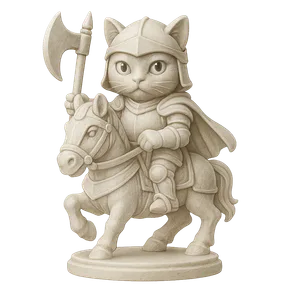
The Knight (The Pouncing Hunter)
3 PointsMovement: Moves in a strict "L-shape": two squares in one cardinal direction, then one square perpendicular. It is the ONLY piece on the board capable of jumping over other friendly or enemy pieces.
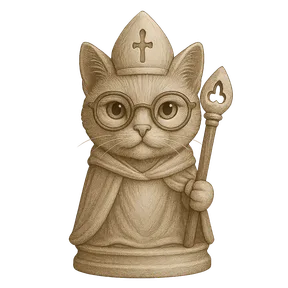
The Bishop (The Diagonal Stalker)
3 PointsMovement: Slides diagonally across any number of unoccupied squares. Because it travels solely along diagonals, a Bishop is strictly bound to its starting color (light-squared or dark-squared).

The Rook (The Castle Tower Cat)
5 PointsMovement: Moves any number of squares horizontally along ranks or vertically along files. A major piece that controls open files and coordinates lethal back-rank attacks.
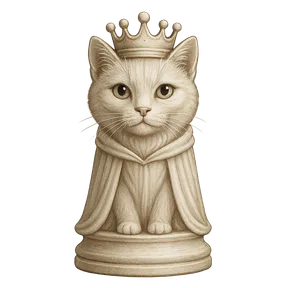
The Queen (The Fluffy Empress)
9 PointsMovement: Combines the devastating power of the Rook and Bishop. Moves any number of squares in any straight direction: horizontally, vertically, or diagonally.

The King (The Regal Sovereign)
Priceless (The Game)Movement: Moves exactly one square in any direction. The King cannot move into any square attacked by an enemy piece.
Check, Checkmate & Stalemate (Patt)
Understanding the difference between Checkmate and Stalemate is the single most important rule for beginners. One wins the game; the other throws away a won position for a draw!
Check (Schach)
⚠️The King is under direct attack by an enemy piece. You MUST escape check immediately using the CPR Rule:
- C — Capture: Take the checking piece.
- P — Protect: Block the line with another piece.
- R — Run: Step the King to an unattacked square.
Checkmate (Sieg!)
👑The King is in check, and there is NO legal move to escape (cannot capture, cannot block, cannot run).
Stalemate (Patt)
🤝The player whose turn it is to move is NOT in check, but has ZERO legal moves anywhere on the board.
The 3 Special Rules of Chess
Beyond basic steps, chess features three historic special moves designed to reward planning, balance piece activity, and protect the King.
Castling (Rochade)
How it works: The King moves two squares towards a Rook, and that Rook hops over the King to the adjacent square.
- Neither the King nor the participating Rook has moved previously in the game.
- All squares between the King and Rook must be empty.
- The King cannot be currently in check.
- The King cannot pass through or land on any square attacked by an enemy piece.
En Passant (In Passing)
How it works: If an enemy pawn advances two squares from its starting rank and lands directly beside your pawn on the 5th rank, your pawn may capture it diagonally as if it had only advanced one square.
- Your pawn must be positioned on the 5th rank (4th rank for Black).
- The enemy pawn must make a two-square advance in a single move.
- The capture MUST be executed immediately on the very next turn, or the privilege is lost forever.
Pawn Promotion
How it works: When any humble pawn battles its way to the opposite side of the board (the 8th rank for White, 1st rank for Black), it is immediately transformed into a Queen, Rook, Bishop, or Knight of your choice.
- Promotion happens on the exact turn the pawn lands on the promotion rank.
- You can have multiple Queens on the board simultaneously — there is no limit.
- Underpromotion to a Knight is sometimes chosen to deliver an immediate surprise checkmate or avoid stalemate.